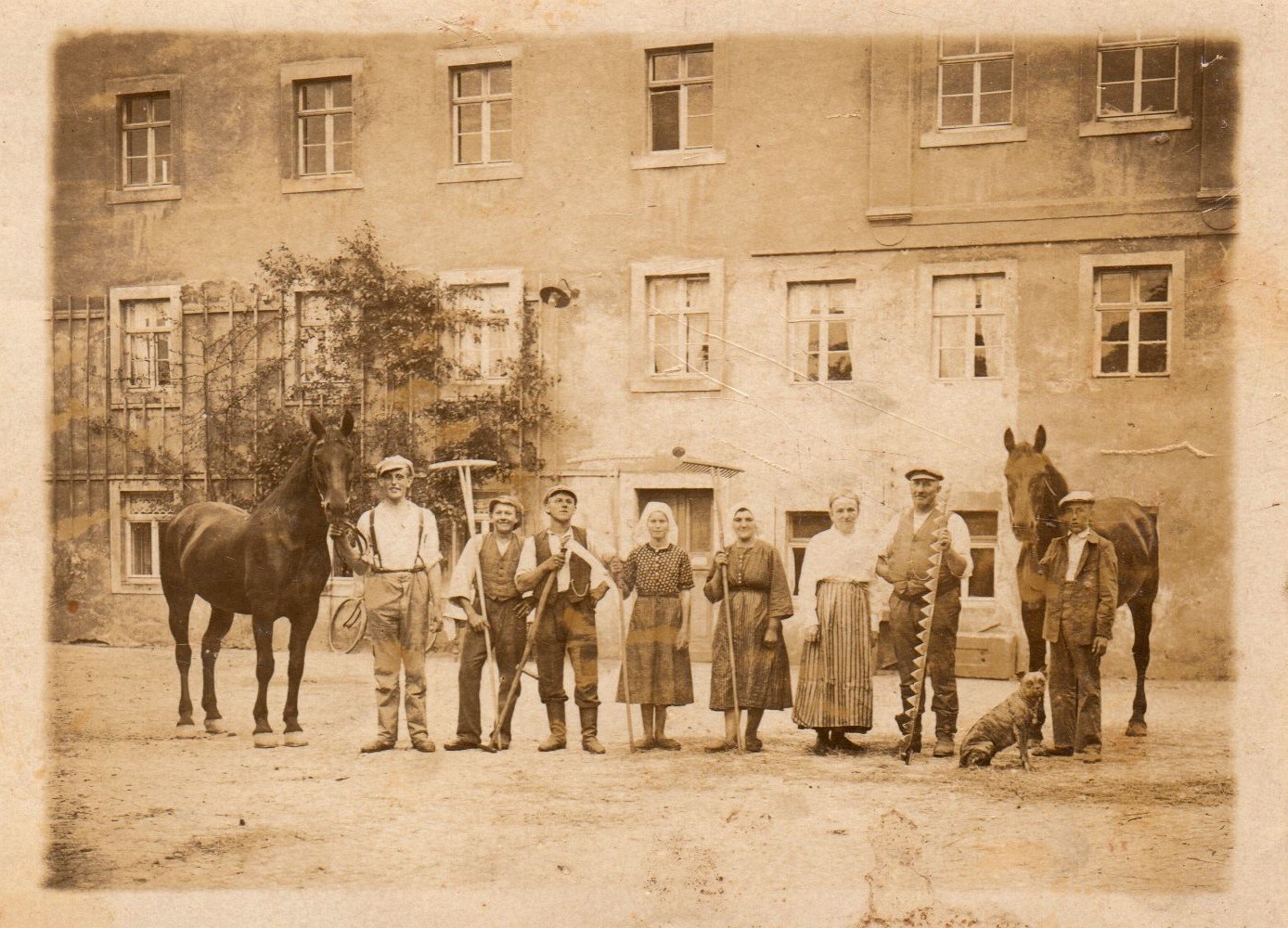
Some places do not tell their story in words – but with the water that has flowed past them for centuries. Müllers Mühle in Folbern is such a place.
Standing on the bank of the Große Röder today, watching the quiet river, it is easy to forget how much power this water once had. For centuries it drove daily life. It turned mill wheels, brought people work, fed families and set the rhythm of an entire farm. The Große Röder still flows past the mill without pause – a silent witness to a long history.
The village of Folbern also looks back on an impressive past. It was first documented in 1291 as “Volbor”. More than a century later, in 1406, records mention a mill alongside farms and gardens for the first time.
It was probably a fulling mill for Großenhain cloth makers. Water power was used to full and compact woollen cloth – an important step in cloth production. Those who used the Röder’s power also cared for it. Mill operators had to maintain dams and banks so the water could do its work reliably.
Old maps describe the mill as a cloth maker’s mill with several runs. Later it became a grinding and fulling mill until 1860, when Großenhain cloth makers sold the business. The former cloth mill became a classic grist mill – and a new chapter began.
The mill took its present form in 1896 when Hugo Schöne had the water mill on the Große Röder rebuilt. What few may have guessed: when his daughter married a miller, not only a new family name came to the farm – a family story began that remains closely tied to this place.
Since the early 20th century the heart of the mill has beat to the rhythm of the Müller family.
Early each morning the weir was checked before work began. Water set the machinery in motion, grain was ground and the scent of fresh rye flour filled the mill. Over generations, rye flour and rye bran were produced here, sought far beyond Folbern and even finding their way to Dresden.
Not every delivery left by motor. Some sacks of flour were still loaded onto horse-drawn carts and taken along country roads to surrounding villages. Livestock often belonged to the mill as on many farms of the time. Work here meant not only grinding but living in tune with the seasons, the weather and the power of water.
A special milestone was the installation of a water turbine in the early 20th century. It gradually replaced older drive technology and still generates electricity for the mill’s own use today. More than a century later it still serves reliably. Standing at the weir today, you look not at a museum piece but at technology that has lived for generations.
Rudolf Müller learned milling from his father, later passed his master craftsman's exam and took over the family business in 1975. For more than three decades the mill was the centre of family life. People worked, repaired, planned and pitched in together.
Reunification changed economic conditions fundamentally. Like many small mills, Müllers Mühle struggled to compete with large industrial operations in the new market economy. In the early 1990s the millstones fell silent.
Grinding ended – but not the story of this place.
Since then the Müller family has lived the change themselves: every conversion, modernisation and extension of the guesthouse was planned and carried out by the family. Step by step today’s guest destination emerged – and further expansion is planned.
While outside the Große Röder quietly follows its course, Müllers Mühle shows a very different face today.
Where the clatter of millstones once shaped daily life, nature’s voices define the place now. On warm summer evenings frogs fill the air with song while bees hum from blossom to blossom. Ducks glide on the Röder or stroll across the meadows as if they had always belonged here.
With luck, attentive visitors spot wild geese resting on their journey. Look closely and you may see a nutria mother with her young among pond, reeds and tall grass.
But Müllers Mühle does not only tell its history – it invites you to become part of it.
Perhaps your day begins with a stroll across the farmyard. Our hens greet you curiously and with luck you collect your breakfast egg from the nest of our “egg girls”. If a few eggs are left over, new chicks may hatch in May or June – a delight for children’s eyes.
A few steps on, our retired pony enjoys gentle strokes, grooming or a short walk with children. If you want to try riding, we can put you in touch with a riding school in the next village.
Depending on the season, the garden offers small treasures. Apples, plums, peaches, figs, currants, elderberries, cherries or blackberries wait to be picked straight from tree or bush – nature often tastes best where it grew.
When the day winds down, the Große Röder shows its most beautiful side. Perhaps you glide silently in the boat, leave everyday life behind and enjoy the river’s special stillness. When the moon mirrors in the Röder and only frogs quack softly around you, moments arise that stay in memory for a long time.
Perhaps that is exactly what makes Müllers Mühle special.
For centuries it has been a place where people, water and nature live together. Once the Große Röder set the pace of work. Today it invites you to pause, breathe deeply and simply enjoy the moment.
The story of Müllers Mühle therefore does not end with a date. It is written a little further every day – by the Müller family, by nature and by the people who become part of this special place for a while. Perhaps you do too.